
 681 459 0519

What is a Restaurant Flash Report? Breaking Down How it Works

Do you know how your restaurant is really performing? If there’s any doubt whatsoever, now is the perfect time to organize a restaurant flash report.
A restaurant flash report is a quick financial snapshot that tracks all of your most important controllable costs. Essentially, it’s a summary of the key operational and financial outcomes of the business in an overall sense.
In this guide, we’ll explain how the information gathered from this report can be used to analyze, optimize, and revolutionize the financial side of your business. Keep reading to find out how.
Restaurant Flash Reports: The Basics
A flash report gives both owners and managers a quick look at recent performance, often using daily sales figures and major operating costs. Rather than waiting for monthly financial reports, you get an earlier real-time indication of how the restaurant is tracking.
A typical report might include:
- Sales revenue: Total sales for the day, shift, or reporting period.
- Food and beverage costs: Spending on ingredients, drinks, and other stock.
- Labor costs: Wages and other relevant staffing expenses.
- Controllable expenses: Operating costs managers have some influence over.
- Cash flow indicators: Useful information about incoming revenue and upcoming payments.
- Performance comparisons: Actual results compared with budgets, forecasts, or previous periods.
The goal is to be able to spot any changes, challenges, or blindspots sooner rather than later. If sales are holding steady but food costs are climbing, this report will give you a reason to investigate before the issue becomes more pronounced in your monthly management accounts.
How Long Does it Take?
A flash report is designed to provide a quick overview, so it should be concise enough for owners and managers to review regularly without interrupting service or shutting up shop.
A lot of restaurants prepare reports daily and use figures from the previous day. Others review performance by shift or produce weekly summaries. However, this all depends on their operations and reporting systems.
Preparation time also depends on how well the restaurant's sales, payroll, inventory, and accounting records are currently organized. Missed invoices, unreconciled transactions, or inconsistent records may mean more time spent checking figures before the report is useful.
A flash report isn't a replacement for full financial reporting, but it can be a very useful exercise. What it offers is an early review of performance, while monthly management accounts offer a broader picture of profitability, liquidity, and the restaurant's overall financial position.

How Is a Restaurant Flash Report Typically Used?
The value of a flash report ultimately lies in what you do with the numbers. Managers can review the figures, compare them with targets or previous periods, and investigate unusual changes while the details are still fresh.
A flash report might prompt you to investigate:
- Rising food costs: Have supplier prices increased, or is the kitchen wasting more ingredients?
- Higher labor costs: Are overtime hours or staffing levels out of line with sales?
- Falling revenue: Are fewer customers visiting, or is the average check lower?
- Unexpected discounts and comps: Are promotions, refunds, or complimentary meals affecting revenue?
- Differences between locations: Is one restaurant performing differently from the others?
As an operator, you can also take this info and provide it to your restaurant accounting team, particularly if they need help with bookkeeping or cashflow management.
Sample Flash Report
The table below illustrates how a restaurant might summarize one day's performance. Please note that these figures are completely hypothetical and designed to be used as an example, not an industry benchmark.
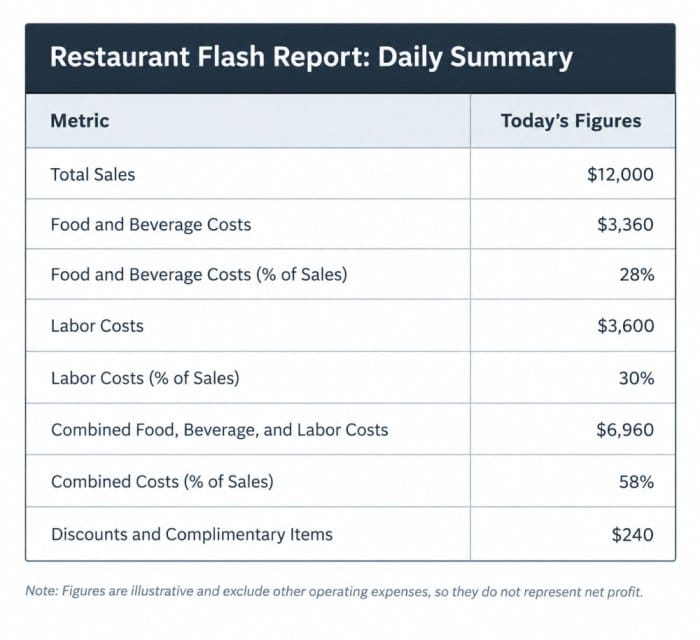
Here, food and beverage costs account for 28% of sales, while labor accounts for 30%. Together, these expenses represent 58% of sales, giving management a quick view of two major controllable cost categories.
The next step is to compare the figures with the restaurant's budget, targets, and previous results. If labor costs are higher than expected, managers might review scheduling and overtime. If food costs have risen, purchasing records and inventory usage deserve closer attention.
How Might It Benefit My Restaurant?
A well-prepared flash report gives restaurant owners an earlier warning when operating costs or sales begin moving in the wrong direction. Rather than waiting for monthly financial reports, you have a regular opportunity to investigate changes and adjust your approach.
Key benefits include:
- Better cost control: Spot unusual changes in food, beverage, and labor costs before they continue unchecked.
- More informed decisions: Use actual sales and expense figures to guide staffing, purchasing, and operational decisions.
- Improved financial visibility: Understand how daily trading affects the restaurant's performance.
- Stronger accountability: Give managers clear figures to review and follow up on.
- Useful location comparisons: Identify differences in performance across restaurants within a group or franchise.
- More effective financial planning: Use recurring trends to inform budgets, forecasts, and spending decisions.
- Knowing when to seek assistance: The data gathered can let you know it’s time to reach out to knowledgeable restaurant accountants.
Flash reports work best when the underlying records are accurate and managers review the results consistently. A single unusual day doesn't necessarily signal a serious problem, so comparisons over time help distinguish normal fluctuations from patterns that deserve attention.
Please note; a flash report also has limits. While it provides a quick operational snapshot rather than a complete picture of profitability and liquidity. Monthly management accounts remain important for reviewing the restaurant's broader financial position.
Find Out Where You Stand with Enlaiven Accounting
The restaurant industry is incredibly fast paced and changes on a dime. This is why regular accounting is more essential than ever before. At Enlaiven, our goal is to make restaurant accounting easier than ever by providing end-to-end support that’s simple, easy, and straightforward.
We’re known for providing a service with:
- Exchange of Ideas & Expertise across the Globe
- No Physical Boundaries
- End to End bookkeeping & Accounting services
- Top-Notch Accounting Professionals
We're not limited by location, and we partner with restaurant operators across the United States. From Arizona to Florida, Georgia, New York, and Pennsylvania, you can always get support from our qualified team.
You can also head here to learn more about our engagement model.

Frequently Asked Questions
What should a restaurant flash report include?
A restaurant flash report typically includes sales revenue, food and beverage costs, labor costs, controllable expenses, cash flow indicators, and comparisons with budgets or previous periods. These figures give owners a quick snapshot of financial performance.
How often should a restaurant prepare a flash report?
Many restaurants prepare flash reports daily using figures from the previous day. Others review performance by shift or weekly, depending on their operations. Regular reporting helps owners identify changes in sales and operating costs sooner.
How do restaurant flash reports help control food and labor costs?
Flash reports highlight changes in food and beverage costs, labor expenses, and their percentages of sales. Owners and managers may investigate supplier price increases, food waste, overtime, or staffing levels to find opportunities to control spending.
How is a restaurant flash report different from monthly management accounts?
A flash report provides a quick snapshot of recent operations, while monthly management accounts offer a broader view of profitability, liquidity, and overall financial performance. Flash reports help identify emerging issues, while monthly accounts support more detailed financial analysis.
When should a restaurant owner seek help from a restaurant accounting team?
Rising controllable costs, inconsistent financial records, cash flow difficulties, or uncertainty about profitability may signal a need for support. Restaurant accountants who specialize in the industry help with bookkeeping, financial reporting, accounts payable and receivable, and cash flow management.


